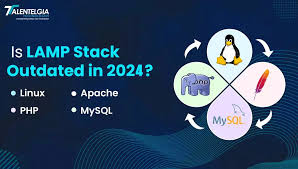
The LAMP stack is a popular open-source software bundle used for full-stack web development. It stands for:
-
Linux: The operating system that provides the foundation for the entire stack.
-
Apache: The web server software responsible for handling HTTP requests and serving web content.
-
MySQL: The relational database management system used to store and manage application data.
-
PHP: The server-side scripting language used to create dynamic web pages and handle application logic. (While PHP is the most common, Perl and Python can also be used in a “LAMP-like” stack).
How the LAMP Stack Functions as Full-Stack:
-
Client Request:A user’s web browser sends an HTTP request for a web page.
-
Apache Server:The Apache web server, running on the Linux operating system, receives the request.
-
PHP Processing:If the request is for a dynamic page, Apache passes it to the PHP interpreter. PHP executes the server-side code, which may involve:
- Interacting with the MySQL database to retrieve or store data.
- Performing calculations or business logic.
- Generating HTML content.
-
MySQL Database Interaction:PHP connects to the MySQL database to perform CRUD (Create, Read, Update, Delete) operations on the stored data.
-
Response to Client:PHP returns the generated HTML (and potentially other assets like CSS and JavaScript) to Apache, which then sends it back to the user’s browser for rendering.
-
Front-end (Client-side):While LAMP primarily focuses on the back-end, the “full-stack” aspect implies the integration of front-end technologies like HTML, CSS, and JavaScript. These are delivered by the LAMP stack to the client’s browser, where they handle the user interface and client-side interactivity.
In essence, the LAMP stack provides all the necessary components to build and deploy a complete web application, encompassing both the server-side logic and data management (back-end) and the delivery of the user interface (front-end).